
What Is Amazon FBA? The Visibility Guide for Amazon Sellers (2026)

Most sellers think FBA is a logistics decision. It’s not. It’s a visibility decision. One that determines whether Amazon’s algorithm works for you or against you.
FBA stands for Fulfillment by Amazon: you send your inventory to Amazon’s warehouse network, and Amazon handles storage, packing, shipping, customer service, and returns. But the operational side isn’t why 82% of Amazon sellers use FBA. They use it because of what it unlocks algorithmically.
This guide covers exactly how FBA works, what it actually costs in 2026, and – most importantly – why it’s the single biggest lever most Amazon sellers have on search visibility and Buy Box performance.
So what exactly is FBA and how does it work?
The mechanics are straightforward. You prepare and ship your inventory to Amazon’s fulfillment network – the specific centre is assigned by Amazon based on inbound placement rules. Once received and checked in, Amazon stores your products in their warehouses until an order comes in.
When a customer places an order, Amazon picks, packs, and ships it – typically same or next-day from fulfillment centres near the customer. They also handle all post-order logistics: customer service queries, returns, and refunds.
From the seller’s perspective, the core workflow looks like this:
- Create your FBA listing in Seller Central (or convert an existing one)
- Prep and label your inventory to Amazon’s requirements (FNSKU labels, polybagging, etc.)
- Book an inbound shipment using the Send to Amazon workflow in Seller Central
- Ship to the assigned fulfilment centre(s)
- Amazon receives, checks in, and stores your inventory
- Orders come in — Amazon fulfils them automatically
- Amazon handles customer service and returns; you manage inventory levels and replenishment
The key thing to understand is that FBA is not just outsourced logistics. It’s a program that grants you access to Amazon’s infrastructure, customer trust layer, and algorithmic rewards simultaneously. Sellers who treat it as ‘just a shipping option’ miss most of the strategic upside.
Why FBA sellers dominate search and the Buy Box
FBA is the fastest route to the Prime badge – and the Prime badge changes everything about how Amazon treats your listings.
When your product is FBA-enrolled, it automatically becomes Prime-eligible. That means it appears in Prime filters, shows the Prime badge in search results, and qualifies for two-day delivery promises. Every time a Prime member filters by Prime, FBM listings disappear from their results.
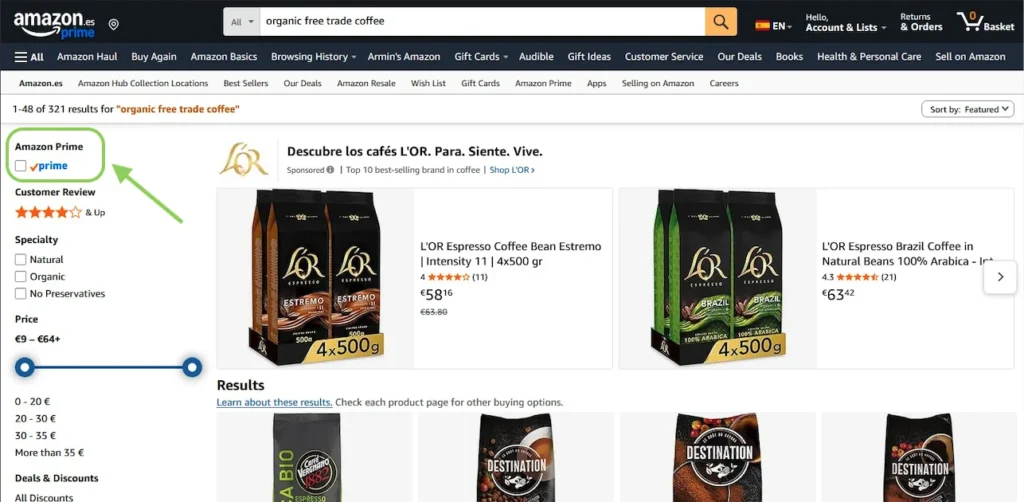
On top of that, FBA status is one of Amazon’s primary Buy Box eligibility signals. Amazon’s algorithm factors in fulfillment reliability, delivery speed, and customer service performance when awarding the Buy Box – and FBA ticks every one of those boxes automatically.
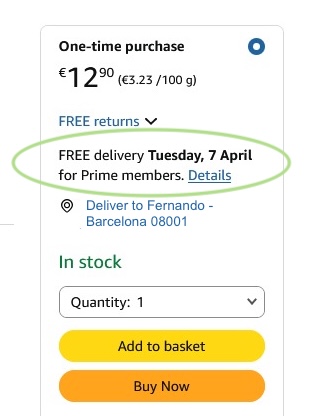
There’s also a direct Amazon SEO component. Amazon’s A10 algorithm gives ranking preference to FBA listings because they’re more likely to result in a positive customer experience – which is what Amazon’s algorithm is ultimately optimizing for.
How FBA feeds the Amazon flywheel
Back in 2001, Jeff Bezos sketched a “Virtuous Cycle” on a napkin: better customer experience → more traffic → more sellers → more selection → lower costs → lower prices → even better customer experience.
The cycle feeds itself — and it’s why the flywheel is Amazon’s most powerful growth model.

FBA is the infrastructure layer that powers that cycle. Here’s why Amazon needs FBA sellers to make the flywheel work:
- FBA guarantees the customer experience Amazon promises: fast shipping, easy returns, consistent service
- FBA sellers fulfil the Prime promise: if a Prime member orders with two-day delivery, Amazon can only guarantee that through FBA
- FBA gives Amazon inventory visibility it can trust for demand planning and search ranking
- FBA delivers the consistent service quality that drives reviews and repeat purchases
This is why Amazon doesn’t just allow FBA. It rewards it algorithmically. The compounding cycle looks like this:
FBA → Prime eligibility → Buy Box advantage → Higher sales velocity → Better rankings → More sales → More reviews → More visibility
Non-FBA sellers can still rank. But they’re working against the flywheel rather than with it. “Marketplace pumps energy into Prime and Prime pumps energy into marketplace” – and if you’re not Prime-eligible, you’re outside that energy loop.
The data: why FBA sellers win
Let’s put some numbers behind the visibility advantage.
The Buy Box reality
82% of all Amazon sales flow through the Buy Box. Most shoppers don’t comparison shop – they click Add to Cart and move on. The seller who holds the Buy Box wins that sale, which is why winning and keeping the Buy Box is one of the most important things you can do on Amazon.
FBA sellers get systematic preferential treatment in that algorithm. And here’s the part that surprises most sellers: FBA listings can price 10–15% higher than FBM competitors and still win the Buy Box. Amazon weighs fulfillment reliability and Prime eligibility heavily. Being cheaper isn’t enough if you’re FBM.
The Prime conversion gap
Prime members convert at 74% versus 13% for non-Prime shoppers; that’s almost a 6x difference. Prime members have already paid for fast shipping. They trust the returns process. They’re not comparison shopping, they’re buying.
There are 200+ million Prime members globally (according to Bezos’ 2021 shareholder letter, so probably even more than that now), and 65% of Amazon’s customer base holds Prime. Their average annual spend is $1,170 versus $570 for non-Prime customers. When your listings carry the Prime badge (which FBA triggers automatically – here’s how it appears on your listings), you’re reaching a different quality of buyer.
The search ranking factor
Amazon’s A10 search algorithm weighs fulfillment method as a ranking signal. FBA-enrolled listings receive a ranking boost over FBM listings, all else being equal. This means two identical products — same price, same reviews, same copy — will rank differently based purely on fulfillment method. That’s the algorithm. And it interacts directly with how Amazon SEO works at a structural level.
By the numbers
| Metric | Value | Source |
|---|---|---|
| Buy Box share of all Amazon sales | 82% | Amazon / Repricer.com |
| Prime member conversion rate | 74% | Millward Brown Digital, 2015 |
| Non-Prime conversion rate | 13% | Millward Brown Digital, 2015 |
| Prime members globally | 200+ million | Bezos shareholder letter, 2021 |
| Sellers using FBA (% of all Amazon sellers) | 82% | Jungle Scout, 2024 |
| Prime annual spend vs non-Prime | $1,170 vs $570 | CIRP, 2024 |
| FBA Buy Box pricing advantage | Can price 10–15% higher and still win | The Selling Guys, 2026 |
| Sellers using hybrid FBA + FBM | ~22% | Jungle Scout, 2024 |
A quick note on fairness: FBM isn’t worthless. There are specific scenarios where it’s the right choice (we’ll cover those further down). But the data is clear — if you’re not FBA, you’re working harder for smaller results.
What FBA actually costs in 2026
FBA costs confuse a lot of sellers — partly because there are multiple fee types, and partly because things changed significantly at the start of 2026. Let’s break it down clearly.
Fulfillment fees
These are per-unit fees charged every time Amazon ships an order. They vary by product size and weight:
| Product size tier | Fulfillment fee |
|---|---|
| Small standard (≤16 oz) | $3.11 – $3.70 |
| Large standard (≤20 lb) | $3.73 – $6.97+ |
| Large bulky | $9.66 + $0.38/lb |
| Extra-large | $26.38 – $195+ |
For most small/standard products, you’re looking at $3–4 per unit fulfilled – often competitive with what you’d pay a 3PL or postal carrier for equivalent service. Use Amazon’s FBA Revenue Calculator to model your specific products before making any decisions.
Storage fees
Amazon charges monthly storage fees based on how much space your inventory occupies in their warehouses:
- January–September: $0.78 per cubic foot
- October–December: $2.40 per cubic foot (a 3x increase for peak season)
The Q4 spike is important to plan around. Stock you send in September will cost three times as much to store by October. If you’re carrying slow-moving inventory, watch your aged inventory surcharge exposure carefully – surcharges begin at 181 days and the costs stack up fast. You’ll also want to keep an eye on low inventory surcharge fees, which kick in from the other direction if you run too lean.
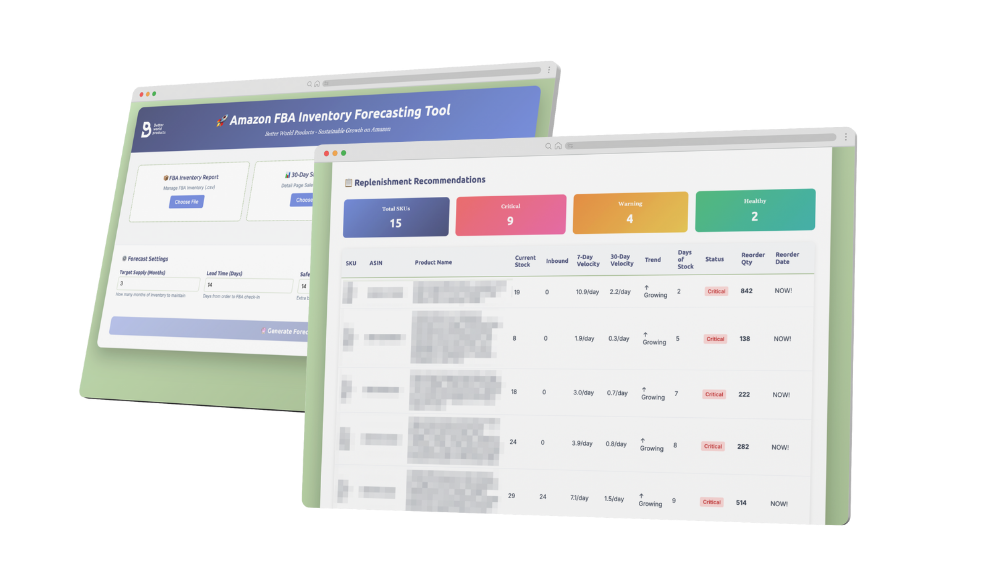
Stop guessing on your FBA shipments
Download our free forecasting tool and start planning with confidence – no spreadsheets required!
Critical 2026 changes – read carefully
Two things changed on January 1, 2026 that every FBA seller must know:
- Amazon discontinued FBA Prep and Labelling Services. If you previously relied on Amazon to prep, label, or package your items at the warehouse, that option is gone. You now need to prep everything before it arrives – or use a third-party prep service.
- Inbound defect fees increased 10–80x. Shipments that don’t meet Amazon’s requirements (wrong labels, incorrect packaging, missing prep) used to cost $0.02–$0.07 per unit in penalties. They’re now $0.32–$5.72 per unit. Getting your prep right isn’t optional anymore.
- For help: our Amazon Barcode 101 guide covers every FNSKU and labelling requirement you need before sending a shipment.
Hidden costs to factor in
Beyond Amazon’s fees, make sure your unit economics include:
- Inbound shipping to Amazon’s fulfillment centres (your cost)
- Prep services if you’re outsourcing prep (now that Amazon no longer offers it in-house)
- Returns processing – Amazon handles it, but you’re responsible for restock or disposal decisions
- Lost inventory – Amazon occasionally misplaces stock; FBA inventory reimbursement claims exist, but you need to file them yourself
None of these make FBA unviable. But they need to be in your unit economics calculation, not an afterthought.
FBA vs FBM: a decision framework
FBA is the right choice for most Amazon sellers, but not all. Here’s how to think about it for your specific situation.
FBA tends to make sense when…
- Your products are small and lightweight (lower fulfillment fees)
- Products move quickly: minimizes storage and aged inventory risk
- You’re in a Prime-dependent category (electronics, health, beauty, household)
- Your margins are 20%+ with room to absorb FBA fees profitably
- You’re competing in a category where the Buy Box is heavily contested
- Customer service load is significant and you’d prefer Amazon handle it
FBM might make more sense when…
- Products are oversized, heavy, or awkwardly shaped (FBA fees become prohibitive)
- Products sell slowly and storage costs would erode margins before they sell
- You sell custom or made-to-order products with variable production lead times
- Your branded unboxing experience is a core differentiator (FBA uses Amazon’s generic packaging)
- You have existing fulfillment infrastructure that’s already highly efficient
If FBM is the right route for some or all of your products, our guides to creating an FBM listing and bulk uploading FBM listings walk through the process.
The hybrid approach (around 1 in 5 sellers use this)
You can run FBA and FBM simultaneously on the same ASINs. List products as FBA for Prime eligibility and Buy Box preference, but maintain an FBM backup. When FBA inventory runs out or inbound shipments are delayed, the FBM listing keeps orders flowing. Around 22% of sellers use both FBA and FBM strategically. For high-velocity products, it’s worth considering.
A note for sustainable brands
If you carry eco-certified products, FBA adds a layer of strategic benefit beyond visibility. The Climate Pledge Friendly badge combined with FBA’s Prime badge creates a compounding advantage in both algorithm preference and customer trust. Shoppers searching with sustainability filters are more likely to see your products – and more likely to trust the fast-shipping promise FBA provides.
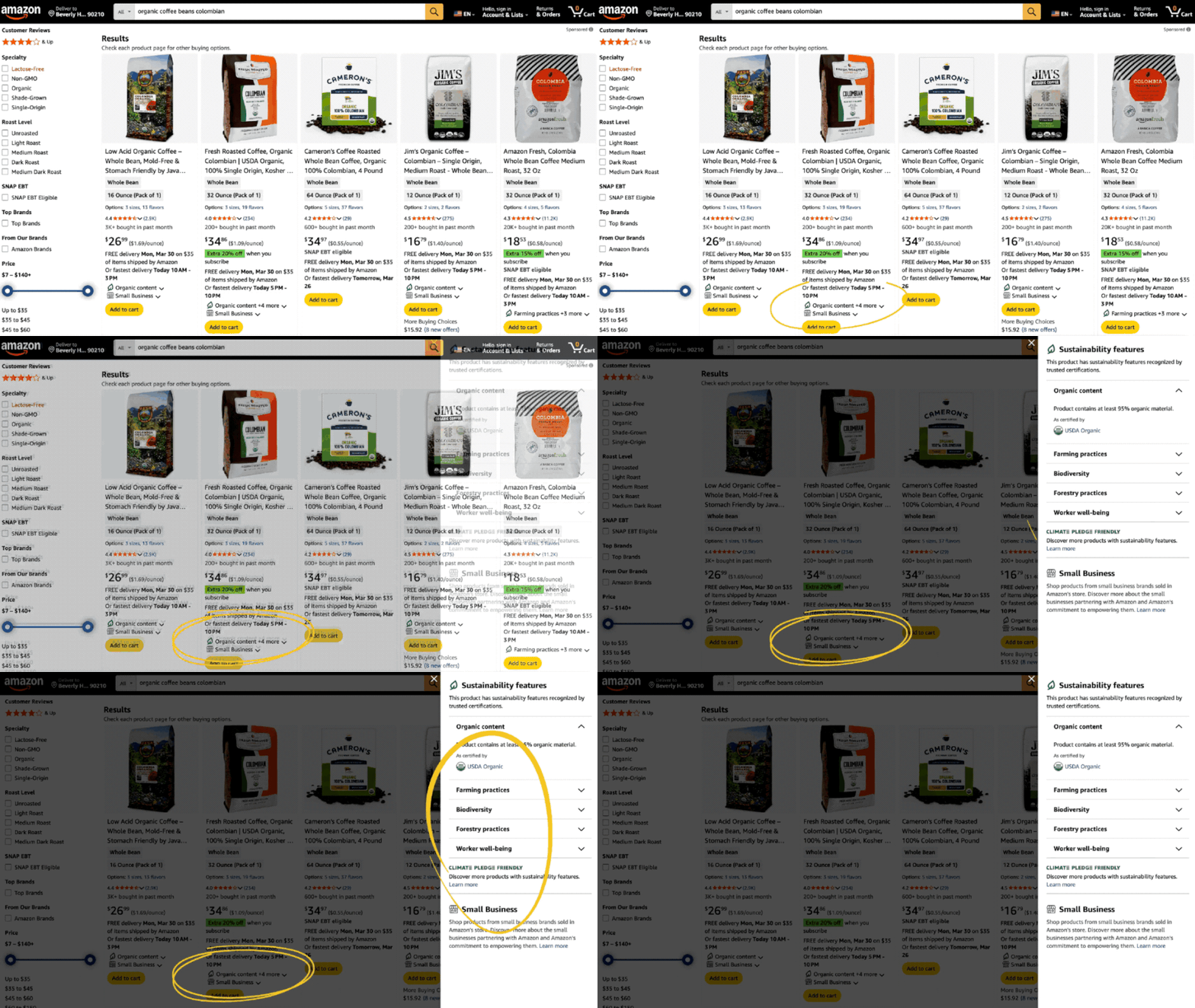
And if you hold (or are considering) the Compact by Design certification, there’s a direct financial benefit: smaller, more efficient packaging not only reduces your FBA fulfillment fees – it supports your sustainability messaging at the same time.
How to get started with FBA
If you’ve decided FBA is right for your products, here’s how to approach the transition without making expensive mistakes.
Step 1: Model the unit economics first
Don’t move everything to FBA at once. Start by using Amazon’s FBA Revenue Calculator to model the numbers for your top products. Input your dimensions, weight, and current margins. You’ll see quickly whether FBA fees leave room for profit.
Prioritize your fastest-moving, highest-margin SKUs for the first FBA shipment. Get comfortable with the process before expanding to your full catalogue.
Step 2: Nail your prep requirements
This is where sellers stumble. As of January 2026, Amazon will not prep your items, and the penalty for sending non-compliant shipments is steep. Before you book your first inbound shipment, make sure you understand:
- FNSKU labelling requirements for each product
- Polybagging rules for items that require it
- Expiration date requirements for food and consumables
- Bundling and packaging requirements
Our Amazon Barcode 101 guide covers everything in one place.
Step 3: Create your FBA listing
If you’re already selling FBM, you’ll convert your existing listing or create a parallel FBA one. Walk through our FBA product listing guide for the step-by-step, then follow the Send to Amazon workflow to book and ship your first inbound.
Step 4: Build your inventory rhythm
The biggest FBA mistake new sellers make is either sending too much inventory (and paying aged inventory fees) or too little (going out of stock and losing ranking momentum). Set up replenishment alerts to catch low-stock situations early, and build a reorder cadence based on your sell-through rate plus inbound lead time.
Frequently asked questions
What does FBA stand for?
FBA stands for Fulfillment by Amazon. It’s Amazon’s service where sellers send inventory to Amazon’s warehouses and Amazon handles storage, shipping, customer service, and returns on their behalf.
Is Amazon FBA worth it?
For most sellers of small-to-medium-sized products with healthy margins – yes. The combination of automatic Prime eligibility, Buy Box algorithmic advantage, and lower per-unit shipping costs makes FBA financially competitive and strategically valuable for the majority of Amazon product categories. The main exceptions are oversized products, very slow-moving inventory, or products with custom fulfilment requirements.
How much does Amazon FBA cost?
FBA costs include fulfillment fees (per unit shipped, starting at $3.11 for small standard products), monthly storage fees ($0.78/cubic foot standard, $2.40/cubic foot during Q4), and aged inventory surcharges for stock held longer than 181 days. You’ll also need to factor in inbound shipping costs and prep services, since Amazon discontinued its own prep offering in January 2026.
What’s the difference between FBA and FBM?
FBA (Fulfillment by Amazon) means Amazon stores and ships your products from their warehouses. FBM (Fulfillment by Merchant) means you handle storage and shipping yourself. FBA provides automatic Prime eligibility and Buy Box algorithmic preference; FBM gives you more control over packaging and fulfilment, typically at the cost of visibility and conversion rates.
Can I use both FBA and FBM at the same time?
Yes – this is called a hybrid strategy. You can run FBA for your primary listings while maintaining an FBM backup. Only about 9% of sellers currently do this, but it’s an effective way to protect against stockouts or inbound shipping delays.
Does FBA affect Amazon SEO?
Yes. Amazon’s A10 search algorithm considers fulfillment method as a ranking signal. FBA-enrolled listings receive a ranking boost over FBM listings, all else being equal. Combined with the higher conversion rates that come from Prime eligibility, FBA tends to improve organic rankings over time.
What happened to Amazon’s FBA Prep and Labelling Services?
Amazon discontinued FBA Prep and Labelling Services on January 1, 2026. Sellers must now prepare and label all inventory before sending it to Amazon’s fulfillment centres. Third-party prep services are available for sellers who need help with this step.
How does FBA affect the Amazon Buy Box?
FBA sellers receive systematic preferential treatment in Amazon’s Buy Box algorithm. Not only are FBA listings weighted higher, but FBA sellers can price their products 10–15% higher than FBM competitors and still win the Buy Box. This is one of the most powerful financial arguments for FBA: it allows you to command a higher price while maintaining visibility.
Key takeaways
✔ FBA is a visibility decision, not just a logistics one. The Buy Box algorithm systematically favours FBA, and 82% of Amazon sales flow through the Buy Box.
✔ Prime members are Amazon’s best customers. 74% conversion rate vs 13% for non-Prime. FBA is the only reliable way to consistently access that audience.
✔ The Amazon flywheel rewards FBA sellers. Prime eligibility → higher conversions → better rankings → more visibility. It’s a self-reinforcing cycle that’s hard to build without FBA.
✔ FBA costs are manageable if you model them first. Use Amazon’s FBA Revenue Calculator before switching. The fees are real, but so is the sales lift.
✔ 2026 changed the prep game. Amazon no longer handles prep. Get your labelling and packaging right before your first shipment — inbound defect fees are now 10–80x what they used to be.
✔ Sustainable brands have extra reason to consider FBA. Climate Pledge Friendly + Prime badge = compounding advantage in algorithm and customer trust.

Not sure if FBA is right for your products?
We’ve helped dozens of sustainable brands navigate the FBA decision – from unit economics to inventory strategy and setup. Send us a link to your listing and we’ll give you our honest take.


