Amazon PPC 101: the complete guide to start advertising profitably

You’re spending money on Amazon advertising. But is it working – really working? Not just generating sales, but generating profitable sales that grow your brand without bleeding your margins dry?
If your ACoS makes you wince every time you check your dashboard, or if your campaigns feel like a black box that only Amazon truly understands, you’re in good company. Most sellers we talk to are in one of two places: either they haven’t started advertising because the learning curve feels overwhelming, or they’re spending but can’t confidently say whether their amazon ppc strategy is actually making them money.
Here’s the thing – Amazon PPC isn’t optional anymore. Organic visibility alone won’t cut it, especially if you’re selling a premium product in a category crowded with cheaper alternatives. But “just run some ads” isn’t a strategy. It’s a hope. And hope is expensive on Amazon.
This guide covers the complete Amazon advertising strategy we use to help sustainable brands grow profitably – the same approach that took one client from a 257% ACoS to 14% while doubling their sales. We’ll walk through everything from campaign types and structure to bidding, optimization, and the metrics that actually tell you whether your ads are working.
What you’ll learn:
- How the three Amazon ad types work and when to use each one
- The Protect, Profit, Grow framework for building a profitable PPC foundation
- How to structure campaigns that don’t become an unmanageable mess
- Keyword strategy: finding the right search terms and eliminating the wrong ones
- Bidding and budget management without the anxiety
- The metrics that matter (and the ones that mislead)
- A practical optimization workflow you can use weekly
- The most common PPC mistakes and how to avoid them
Let’s get into it.
What is Amazon PPC?
Amazon PPC (pay-per-click) is Amazon’s advertising system where you bid on placements across the platform and only pay when a shopper clicks your ad. Your ads can appear in search results, on competitor product pages, and across Amazon’s broader network.
There are three core ad types – Sponsored Products, Sponsored Brands, and Sponsored Display – each serving different strategic purposes. Unlike Google Ads, Amazon PPC operates inside a marketplace where shoppers already have purchase intent. Someone searching “organic dog treats” on Amazon isn’t browsing. They’re buying.
That’s what makes Amazon advertising so powerful for brands with quality products. You’re reaching people at the exact moment they’re ready to make a decision. The question isn’t whether to advertise – it’s how to do it in a way that drives profitable growth rather than just vanity sales numbers.
Why Amazon PPC matters for sustainable brands
If you’re selling a premium, sustainably-made product, you already know the challenge: your product costs more to make, which means it costs more to buy. Competing on price isn’t an option. So you need to compete on visibility, relevance, and trust.
That’s exactly where PPC fits in. Here’s why it’s non-negotiable:
Organic rank requires sales velocity. Amazon’s algorithm rewards products that sell. Advertising generates the sales velocity that improves your organic ranking, which generates more organic sales, which improves your ranking further. It’s the Amazon sales flywheel in action. And PPC is often the push that gets the wheel spinning.
Premium products need more customer education. Shoppers comparing a $32 organic dog food to an $18 conventional option need reasons to choose yours. PPC gets your product in front of the right shoppers and – when combined with strong listing copy and A+ Content – gives you the space to make that case.
Your competitors are already advertising. Even in sustainability-focused categories, brands are bidding on your keywords (and your brand name). Without a PPC strategy, you’re handing those customers to someone else.
Badges and certifications become more visible. If your product has the Climate Pledge Friendly badge or similar sustainability certifications, advertising puts those badges in front of more shoppers – turning your values into a competitive advantage.
💡 BWP Pro Tip: For sustainable brands, PPC isn’t just about sales — it’s about making sure the right products win. Every time your premium, responsibly-made product outperforms a cheaper, less sustainable alternative in search results, that’s impact. Your ad spend is an investment in visibility for better products.
The three Amazon ad types
Before building your strategy, you need to understand your tools. Amazon offers three campaign types, and each plays a different role. For a deeper breakdown of every targeting option within each type, check out our complete guide to Amazon advertising targeting types.
Sponsored Products
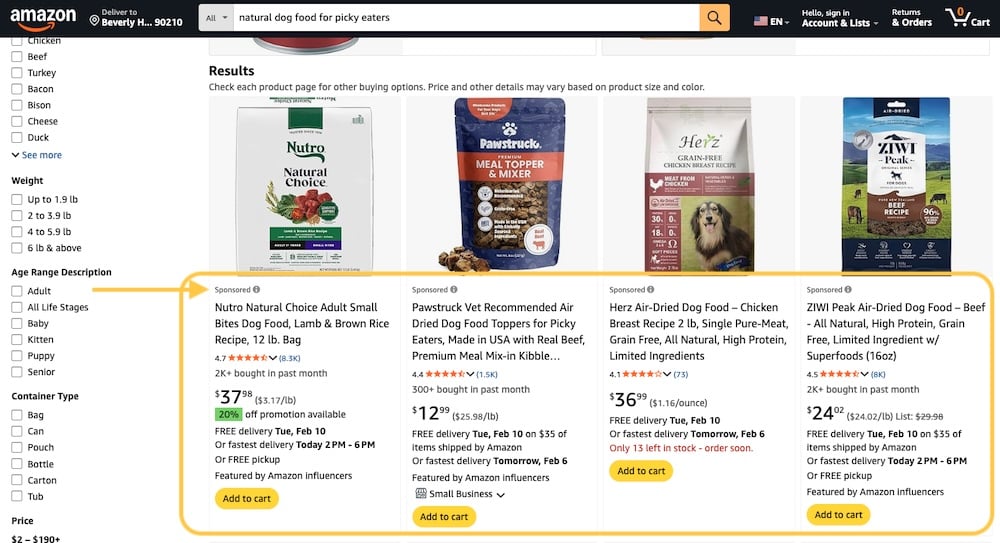
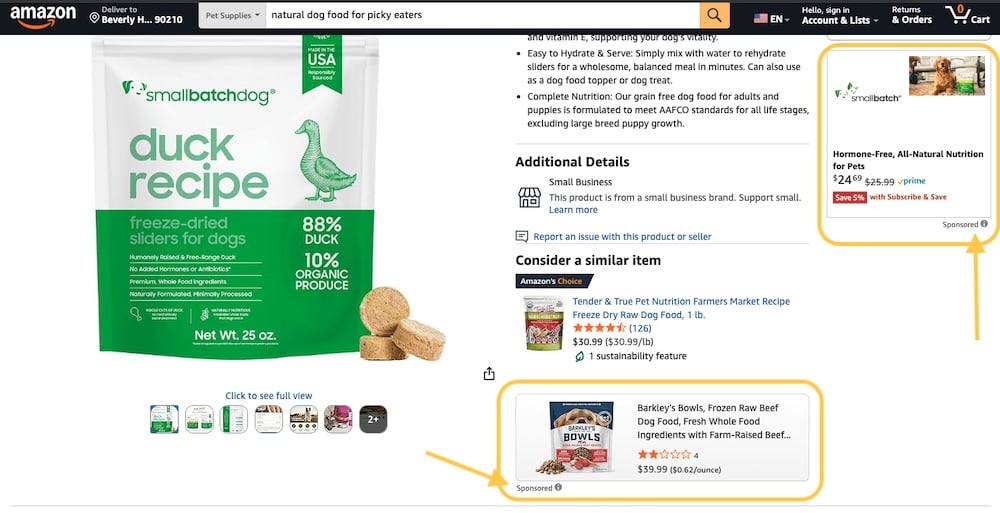
What they are: The workhorse of Amazon PPC. These ads promote individual product listings and appear in search results and on product detail pages. They look nearly identical to organic listings, which is why they convert well.
When to use them: Always. Sponsored Products should form the foundation of every amazon ppc strategy. They drive the most direct, measurable sales and often account for over 90% of ad sales.
Best for: Capturing high-intent keyword searches, defending your brand name, appearing on competitor product pages, and building the sales velocity that improves organic ranking.
Sponsored Brands
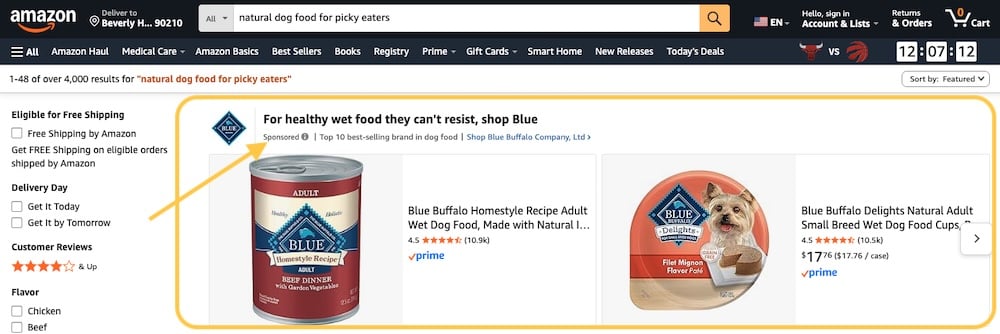
What they are: Banner-style ads that feature your brand logo, a custom headline, and multiple products. They appear at the top of search results and can link to your Amazon Storefront or a custom landing page. Video format is also available.
When to use them: Once you have Brand Registry and want to increase brand awareness and drive shoppers to your full catalog – not just one product.
Best for: Brand-building, telling your sustainability story, showcasing product range, driving traffic to your Storefront, and top-of-funnel awareness.
Sponsored Display
What they are: Display ads that can target audiences based on shopping behavior, interests, or specific product pages. They appear on product detail pages, alongside search results, and across Amazon’s extended network (Twitch, IMDb, third-party sites).
When to use them: Once your Sponsored Products and Brands foundation is solid. Sponsored Display is best used for retargeting shoppers who viewed your products but didn’t buy, and for reaching shoppers browsing in your category.
Best for: Retargeting, audience building, category awareness, and defending your own product pages from competitor ads.
| Ad Type | Placement | Requires Brand Registry? | Primary Goal |
|---|---|---|---|
| Sponsored Products | Search results, product pages | No | Direct sales, keyword ranking |
| Sponsored Brands | Top of search, video placements | Yes | Brand awareness, catalog discovery |
| Sponsored Display | Product pages, off-Amazon | Yes | Retargeting, audience building |
The Protect, Profit, Grow Framework
Here’s where most sellers get it wrong: they jump straight into aggressive campaigns on day one, burn through budget chasing broad keywords, and then conclude that “PPC doesn’t work.” The truth, is they skipped straight to growth before building anything worth growing.
Profitable advertising follows a specific order. Each phase creates the conditions for the next. Skip a phase and the math breaks. The PPG framework is what helps us create an inevitable flywheel of success.
This is the same framework we applied for a pet supplements brand that came to us spending wildly with a 257% ACoS. Within months, we had that down to 14% – and their ad sales doubled.
Phase 1: protect
The goal: Defend your brand – these are the highest-converting, lowest-cost campaigns in your entire account.
If you’re not bidding on your own brand name, your competitors are. When someone searches your brand on Amazon, competitors can (and will) show up above your organic listing and steal your traffic. Brand protection campaigns fix this.
The campaigns:
- Sponsored Products – Bid on your own brand name so competitors can’t steal your traffic. Use exact match and phrase match keywords for your brand terms.
- Sponsored Brands – Own the top of search results when shoppers look for your brand. This is prime real estate.
- Sponsored Display – Protect your product pages from competitor ads appearing on your own listings.
Brand protection campaigns usually run at very low ACoS (often under 10%) because the conversion rate is high. These customers already know and want your product – they just need to find it. Think of this as protecting revenue you’ve already earned through brand building.
Monitor the search term report weekly for branded queries you may have missed.
Phase 2: profit
The goal: Build a self-reinforcing profit engine that finds what converts and scales the winners.
This is where most of your campaign work happens. The system works as a cycle:
Discover → Isolate → Profit → Reinvest → Discover again
You cast a wide net to find converting search terms, isolate the winners into dedicated campaigns, drive profitable sales, then reinvest that margin into more discovery. The cycle never stops.
The campaigns:
- Recapture interested shoppers – Use Sponsored Display retargeting to re-engage people who viewed your product (or others) but didn’t purchase. They already showed intent – sometimes they just need a reminder.
- Cast a wide net – Show up on thousands of search terms at low cost per click. Auto campaigns and broad match campaigns are your discovery engines. The volume means you find profitable keywords fast, and the math is on your side.
- High-intent keyword campaigns – Launch precise campaigns on the keywords most likely to drive profitable sales. For sustainable brands, this often means terms like “organic [product],” “natural [product],” “eco-friendly [product],” and specific certification terms. These shoppers are actively looking for what you offer.
- Proven winner campaigns – Isolate your best-performing search terms into dedicated exact match campaigns for maximum efficiency. These are the workhorses of your account.
💡 BWP pro tip: Don’t chase every high-volume keyword in your category. A keyword like “dog food” gets enormous traffic, but the conversion rate for a premium $32 product at that level of generality is going to be painful. Instead, focus on mid-tail and long-tail keywords that reflect specific intent: “grain free dog food for active dogs” or “organic dog treats made in USA.” These lower-volume terms typically convert at 2–3x the rate and cost significantly less per click.
Phase 3: grow
The goal: Accelerate what’s working – expand reach, build visibility, and improve organic position.
With a profitable engine running, these campaigns are an investment in growth. The returns show up in your organic ranking and total revenue over time, not just in direct ad-attributed sales.
The campaigns:
- Organic ranking campaigns – Invest in pushing your products up in search results so you earn sales without paying for every click. Higher sales velocity on key terms improves your organic position.
- Category brand visibility – Headline and video ads (Sponsored Brands) that claim premium real estate on non-branded search results. This builds awareness with shoppers who don’t know your brand yet.
- Competitor targeting – Show up when shoppers search for competing brands to capture customers considering alternatives. Use product targeting to appear on competitor detail pages.
- Top-of-funnel display – Broad audience targeting through Sponsored Display to introduce your brand to new potential customers at scale.
Use advertising portfolio management to organize campaigns by phase, product line, or strategic goal.
Why the order matters
Each phase creates the conditions for the next:
Protect locks down your cheapest, most profitable traffic. Profit uses that foundation to build an engine that finds and scales winners. Grow invests the margin from that engine into ranking, visibility, and market share.
Skip a phase and the math breaks. Run growth campaigns without a profit engine and you’re subsidizing awareness with no way to recoup it. Run profit campaigns without brand protection and competitors siphon off the customers you’re paying to attract.
💡 BWP pro tip: We don’t advance until the data says you’re ready. Moving into Grow campaigns with a weak listing or thin margins just burns money on clicks that won’t convert. Listing quality, conversion rate, and margin are the gates between phases — not timelines. We advance when the numbers support it, not when the calendar says so.
The essentials of good campaign structure
Organize by strategic intent, not just product. Don’t just create one campaign per product. Create campaigns based on what you’re trying to achieve: brand protection, category growth, competitor targeting, retargeting, and/or discovery.
Separate match types. Run exact match, phrase match, and broad match keywords in separate campaigns (or at minimum, separate ad groups). This gives you control over bids and budgets at the match type level, allows you to better optimize placement and audiences in different ad pools (match types) and prevents Amazon from favoring one match type over another within the same campaign.
Use a consistent naming convention. Every campaign name should tell you what it is at a glance. Include: the ad type, the targeting type, the product or product group, and the match type. Everything you have consistently in a campaign name allows you to filter by search through those campaigns or create more robust reporting in spreadsheets.
Something like SP | Exact | Organic Dog Treats | Brand Defense is immediately clear.
Something like Campaign 47 - New is not.
Keep auto campaigns separate. Automatic targeting campaigns are useful for keyword discovery, but they need their own budget and their own bid strategy. Treat them as research tools that feed keywords into your manual campaigns.
Here’s a simplified example of how this might look for a single product line:
| Campaign | Type | Purpose | Budget Priority |
|---|---|---|---|
| SP – Brand Protection – Exact | Sponsored Products | Protect brand searches | High (low ACoS) |
| SP – Category – Exact | Sponsored Products | Proven high-converting terms | High |
| SP – Category – Phrase | Sponsored Products | Capture keyword variations | Medium |
| SP – Category – Broad | Sponsored Products | Keyword discovery | Low-Medium |
| SP – Auto | Sponsored Products | New keyword discovery | Low |
| SP – Product Targeting – Competitors | Sponsored Products | Show on competitor pages | Medium |
| SB – Category – Video | Sponsored Brands | Brand awareness, top of search | Medium |
| SD – Retargeting – Views | Sponsored Display | Recapture interested shoppers | Low-Medium |
A structure like this scales. As you add products or product lines, the pattern repeats. And when something isn’t working, you can isolate and fix the problem without disrupting everything else.
💡 BWP Pro Tip: Transparent campaign naming isn’t just an organizational nicety — it’s a trust signal. We’ve seen accounts handed over from other agencies where every campaign was named with cryptic internal codes. That’s not complexity — it’s a lock-in tactic. You should be able to look at your own ad account and understand exactly what every campaign does. If you can’t, that’s a red flag.
Keyword strategy and targeting
Your keywords determine which shoppers see your ads. Get this right and you’re showing up for customers who are already looking for what you sell. Get it wrong and you’re paying for clicks that never convert.
Finding the right keywords
Start with three sources:
1. Your own search term report. If you’re already running ads, your search term report is a goldmine. It shows you exactly what shoppers typed before clicking your ad and whether they bought. Harvest the converting terms and add them as exact match keywords.
2. Competitor research. Tools like Helium 10 (we’re a trusted partner) let you see which keywords competitors rank for. Focus on terms where your product offers a genuine advantage – better ingredients, sustainability credentials, stronger reviews.

Drive results with Helium 10’s powerful tools
Get 20% off your first 6 months using promo code BETTERWORLD20
3. Customer language. Read your reviews and your competitors’ reviews. The language customers use to describe products is often different from the language brands use. If customers call your product “natural dog food for picky eaters,” that’s a keyword worth targeting – even if you’d never write it on your packaging.
Match type strategy
Each match type serves a different purpose in your amazon ppc management workflow:
Exact match: Highest control, highest efficiency. Your ad only shows when someone searches your exact keyword (or very close variants). Use for your proven, highest-converting terms. This is where most of your budget should eventually flow.
Phrase match: Moderate control. Your ad shows when the search includes your keyword phrase, with additional words before or after. Use for expanding reach around proven themes.
Broad match: Lowest control, widest reach. Amazon will show your ad for searches it considers related to your keyword. Use deliberately for keyword discovery with tight budget limits and frequent negative keyword management. Given Amazon’s tendency to show broad match to “broaden” its search terms beyond the actual keyword, I recommend you use a broad match modifier.
Negative keywords: the unsung hero
Negative keywords are just as important as your regular keywords. They tell Amazon which searches you don’t want to appear for. Without them, broad and phrase match campaigns will inevitably spend money on irrelevant searches.
💡 BWP pro tip: Focus on negative exact and use things like negative phrase sparingly. We’ve seen some serious horror stories where Amazon matched a negative phrase to a misspelling that was actually the main keyword. Their ad spend disappeared and the brand could not figure out what was going on until Q4 was over and all they had was a bunch of overstocked inventory.
Check your search term report weekly. Any search term that’s getting a lot of clicks but no conversions (look for at least 10 clicks but ideally 15-20) should be added as a negative keyword. Common negatives for premium sustainable brands include: “cheap,” “budget,” “discount,” “bulk wholesale,” and competitor brand names you don’t want to bid on in that campaign.
Do not automate this process. It needs to be hands-on.
Bidding and budget management
This is where the anxiety lives. How much should you bid? How much should you spend? What if Amazon runs through your budget by noon?
Let’s demystify it.
How Amazon’s bidding works
Amazon PPC runs on a second-price auction. You set a maximum bid, but you only pay $0.01 more than the next-highest bidder. So if you bid $1.50 and the next bidder is at $0.80, you pay $0.81. This means your bid is a ceiling, not a fixed cost (this ignores placement modifiers and up and down bidding strategies which can go above your bid).
Setting your initial bids
For new campaigns, start with Amazon’s suggested bids as a baseline. Then adjust based on your target ACoS. A rough formula:
Target bid = Average selling price × Target ACoS × Expected conversion rate
For example: A $30 product with a 25% ACoS target and 10% conversion rate → $30 × 0.25 × 0.10 = $0.75 starting bid.
This is a starting point, not a permanent setting. Let the data tell you where to adjust.
Bid adjustments by placement
Amazon lets you increase bids for specific placements: top of search (first page), Rest of Search, and product pages. Top-of-search placements typically convert at higher rates, so it often makes sense to bid more aggressively for them – particularly for your best-performing keywords.
Start with a 25–50% top-of-search adjustment for your strongest exact match campaigns and evaluate after two weeks of data.
Budget management
Finding the right daily budget is a delicate balance between what you can afford and how the ads are performing. Campaigns generally need enough budget to generate data. We like to set initial budgets to get 10 clicks without issue and then adjust based on performance and ad type/strategy.
This is another reason that single keyword campaign structure is so important. You don’t want massive budgets to generate data on all the terms in there. And if your budget is too small then it will suffocate all of the other terms that don’t have enough budget to spend.
A few principles:
- Allocate more budget to campaigns with proven profitability (brand defense, discovery and high-converting exact match)
- Set tighter budgets for unprofitable campaigns (high CPC exact match) – these are necessary to compete for ranking but will look very unprofitable. You’ll want to manage these as an allocated budget rather than making adjustments based on performance.
- Monitor budget utilization & performance daily at first, then weekly once you’ve established patterns.
The metrics that actually matter
Amazon gives you a lot of data. The trick is knowing which numbers tell you the truth and which ones lie – or at least mislead.
ACoS (advertising cost of sale)
What it is: Ad spend ÷ ad-attributed sales × 100. If you spent $200 and generated $1,000 in ad sales, your ACoS is 20%.
What it tells you: How efficiently a specific campaign or keyword is converting ad spend into ad-attributed sales.
The catch: ACoS only measures direct ad revenue. It doesn’t account for the organic sales that advertising generates. A campaign with a 35% ACoS might look unprofitable in isolation – but if it’s driving organic rank improvements that generate three times more organic sales (or subscription purchases), it’s actually a great investment.
TACoS (total advertising cost of sale)
What it is: Total ad spend ÷ total revenue (organic + ad-attributed) × 100.
What it tells you: The true cost of advertising relative to your entire business. This is the metric we watch most closely because it reveals whether your advertising is building a sustainable business or creating dependency on paid traffic.
Healthy TACoS ranges:
| Brand Stage | Typical TACoS Range |
|---|---|
| Launch phase (first 6 months) | 20–30% |
| Growth phase | 10–20% |
| Established, scaling | 8–15% |
| Mature, optimized | 3–8% |
A declining TACoS over time usually means your advertising is working – it’s building organic visibility that reduces your reliance on paid traffic.
ROAS (return on ad spend)
What it is: The inverse of ACoS. Ad-attributed sales ÷ ad spend. A 20% ACoS = 5x ROAS.
When to use it: Some sellers prefer thinking in ROAS because it’s more of an industry standard on other ad platforms. A 5x ROAS means every dollar you spend on ads generates five dollars in ad sales. Functionally, ROAS and ACoS tell you the same thing – use whichever clicks for you 🙂
The metric that ties it all together: breakeven-ACoS & contribution margin
Ultimately, none of these metrics matter if you’re not profitable. The real question is: after Amazon fees, cost of goods, shipping, and advertising, are you making money on each unit sold? If you don’t have your SKU level margins worked out then for the ads you can calculate your break-even ACoS.
To do this, work backwards from your unit economics:
- Selling price: $30.00
- Amazon referral fee (15%): -$4.50
- FBA fee: -$5.50
- Cost of goods: -$8.00
- Margin before advertising: $12.00
- Break-even ACoS: $12.00 ÷ $30.00 = 40%
Anything below a 40% ACoS is profitable for this product. That gives you real clarity on what “good” looks like for your specific situation – instead of chasing someone else’s benchmark.
💡 BWP pro tip: We worked with a dog food brand that came to us with a 257% ACoS – meaning they were spending $2.57 for every dollar of ad sales. By restructuring their campaigns, cutting wasteful spend, and implementing the PPG framework, we brought their ACoS down to 14% and their TACoS dropped 52%. Their ad sales doubled, and their profit margins more than doubled. The lesson: you don’t fix a broken ad account by spending more. You fix it by spending smarter. Read the full case study here.
The weekly optimization workflow
Amazon PPC isn’t something you set up and walk away from. It requires regular optimization – but that doesn’t mean it needs to consume your life. Here’s a simple workflow you can follow.
Daily (5 minutes)
- Check that no campaign has exhausted its budget prematurely
- Glance at spend pacing – are you on track?
- Note any major anomalies (sudden spike in CPC, unusual conversion drops)
If you see any issues, dive in and investigate.
Weekly (30–60 minutes)
1. Harvest search terms. Pull your search term report. Launch high-performing search terms from auto/broad/phrase campaigns in new exact match campaigns.
2. Add negative keywords. Identify search terms with high spend and zero conversions (or unacceptably low conversion rates). Add them as negatives to stop the bleed.
3. Adjust bids. For keywords with strong ACoS and good volume, consider raising bids (slowly) to capture more impressions. For keywords with poor ACoS, lower bids or pause them so you can allocate budget elsewhere.
4. Check budget utilization. If a profitable campaign is consistently hitting its budget cap, increase the budget. If a campaign is barely spending, the bids might be too low or the targeting too narrow.
5. Review new-to-brand metrics. For Sponsored Brands campaigns, check whether your ads are actually reaching new customers or just recapturing existing ones.
Monthly (1–2 hours)
- Review performance trends across campaigns and product lines
- Analyze TACoS trajectory – is it moving in the right direction?
- Identify opportunities for new campaign launches or keyword expansion
- Evaluate campaign structure – do any campaigns need to be reorganized?
- Review conversion rate data to determine if listing improvements could boost ad performance
Quarterly
- Full account audit: Are your campaigns still aligned with business goals?
- Strategic review: Are you in the right categories? Targeting the right competitors?
- Budget allocation review: Is spend distributed optimally across product lines and campaign types?
How PPC and organic work together
One of the most important things to understand about Amazon advertising is that PPC doesn’t exist in a vacuum. It directly influences your organic search ranking.
When your PPC campaigns generate sales for a specific keyword, Amazon’s algorithm registers that sales velocity and improves your organic ranking for that term. Over time, this means more organic traffic. Meaning you can reduce your ad spend on that keyword while maintaining (or even growing) total sales.
This is why TACoS is an important signal. If your TACoS is declining while total sales are growing, it means organic is picking up the slack. Your advertising is building a compounding asset, not a perpetual expense.
The reverse is also true: strong listing content – great titles and bullet points, compelling images, thorough A+ Content – improves the conversion rate of your paid traffic. Better conversion means lower ACoS, which means more room to scale.
That’s why we always recommend addressing listing quality before scaling ad spend. Sending paid traffic to a weak listing is like pouring water into a leaky bucket.
Common Amazon PPC mistakes (and how to avoid them)
After managing ad campaigns across hundreds of brands, we’ve seen the same mistakes come up again and again. Here’s what to watch for.
1. Running only automatic campaigns
Auto campaigns are fine for discovery, but they shouldn’t be your primary strategy. They give Amazon control over which searches trigger your ads, which often means you’re paying for irrelevant traffic. This is especially true during launch, when Amazon won’t know what the product is yet and thus will show it for even broader search terms.
Use auto campaigns to find keywords, then move the winners into manual campaigns where you control bids and targeting.
2. Giant “everything” campaigns
This is the single most common source of wasted ad spend. Shoving a few hundred keywords with all different match types into one campaign is the worst (and laziest) way to “manage” ads. If you’re not breaking down your campaigns into single product, single keyword campaigns 95%+ the time then you are wasting a lot of money and losing a lot of sales.
3. Obsessing over ACoS instead of TaCOS/margin
A campaign with a high ACoS might still be highly valuable if it’s driving organic rank improvements. Conversely, a low ACoS campaign might not be contributing much to your overall business. TACoS gives you the bigger picture as to the role ads are playing in the even more important metric: your margin.
4. Scaling spend before fixing conversion
If your listing has a 5% conversion rate when category average is 12%, throwing more ad budget at it won’t help – it’ll just waste money faster. Fix your listing first. Improve your images, tighten your copy, add A+ Content, get reviews through programs like Amazon Vine.
5. Setting and forgetting campaigns
Amazon’s marketplace is dynamic – competitor bids change, seasonal demand shifts, Amazon updates its algorithm. Campaigns that performed last month may not perform this month. Commit to the weekly optimization workflow above or partner with someone who will.
6. No campaign structure or naming convention
When you can’t tell what a campaign is targeting or why it exists, optimization becomes guesswork. Invest 30 minutes upfront in a clear naming convention and structure. Future-you (or your agency partner) will be grateful.
7. Bidding on every keyword in the category
More keywords ≠ better strategy. Focus your budget on the keywords where your product is genuinely competitive and where the search intent matches what you sell. For premium sustainable products, this often means leaning into specific, intent-rich terms rather than chasing the highest-volume generic terms.
When to manage PPC in-house vs. partner with an agency
This is a real question that deserves an honest answer.
Managing in-house makes sense when:
- You have fewer than 10 active ASINs
- You have someone with dedicated time (minimum 5–10 hours/week)
- Your monthly ad spend is under $5,000
- You’re comfortable learning the platform and staying current on changes
Partnering with an agency makes sense when:
- Your catalog is growing and campaigns are multiplying
- Your team is stretched across too many priorities
- Your ACoS is high and you’re not sure how to fix it
- You want to scale but need strategic guidance, not just execution
- You need someone who understands the intersection of advertising and brand strategy, not just bid management
The right partner won’t just manage your campaigns – they’ll connect your Amazon advertising strategy to your broader brand goals, ensure your listing content supports your ad performance, and keep your margins healthy as you scale.

Stop wasting spend on PPC guesses
If you want help implementing what you just learned, we’ll start with a full account audit and build a strategy around your brand’s goals.
Key Takeaways
- Amazon PPC is a system, not a set-it-and-forget-it task. The Protect, Profit, Grow framework gives you a clear path from foundation to profitable scaling.
- Start with Protect. Brand protection campaigns are the cheapest, highest-converting strategy in your account and defend revenue you’ve already earned.
- Watch TACoS, not just ACoS. TACoS shows you whether advertising is building a sustainable business or creating dependency on paid traffic.
- Fix your listings before scaling ad spend. Better content = better conversion rates = better ad performance. Advertising and listing optimization compound each other.
- Structure and naming conventions aren’t optional. They determine whether your account scales cleanly or becomes an unmanageable tangle.
- Negative keywords prevent wasted spend. Review your search term report weekly and add negatives aggressively — especially broad and phrase match campaigns.
- Your product’s unit economics dictate your target ACoS. Calculate your break-even point so you always know what “profitable” actually means for your brand.
FAQ
How much should I spend on Amazon PPC?
There’s no universal number — it depends on your category, competition, margins, and goals. A useful starting point is 10–15% of your total Amazon revenue allocated to advertising. For product launches, that ratio will be higher (sometimes 25–30%) because you’re investing in visibility before organic rank kicks in. The right question isn’t “how much should I spend?” but “what’s the most I can spend while maintaining my target contribution margin?”
What’s a good ACoS for Amazon advertising?
It depends entirely on your unit economics. A 25% ACoS is great for a high-margin supplement and terrible for a low-margin commodity product. Calculate your break-even ACoS (your profit margin before ad spend divided by your selling price) and work from there. For most sustainable brands with premium pricing, a healthy target ACoS is typically 15–25% for non-branded campaigns, with brand protection campaigns running well below 10%.
How long does it take for Amazon PPC to show results?
Expect 2–4 weeks before you have enough data to make meaningful optimization decisions. Significant performance improvements — like the kind that move your TACoS trajectory — typically emerge over 2–3 months of consistent optimization. Quick wins come from cutting wasteful spend (sometimes you see results within days). Sustainable, compounding improvements take longer and require patience.
Should I use automatic or manual campaigns?
Both, but for different purposes. Automatic campaigns are excellent for keyword discovery — they let Amazon’s algorithm find relevant search terms you might not have thought of. Manual campaigns are where you should direct most of your budget, because they give you control over exactly which keywords you target and how much you bid. The ideal workflow: run auto campaigns on a limited budget, harvest the best-performing search terms, and move them into manual exact match campaigns.
Can I run Amazon PPC without Brand Registry?
You can run Sponsored Products without Brand Registry, but Sponsored Brands and Sponsored Display require it. Since Brand Registry also unlocks A+ Content, Storefronts, and brand analytics, we strongly recommend getting registered before investing heavily in advertising. Learn more in our Brand Registry guide.
Want to go deeper on a specific topic? This guide is part of our Amazon Advertising series. Explore our posts on advertising portfolio management, the search term report, and promotions strategy to keep building your PPC knowledge.